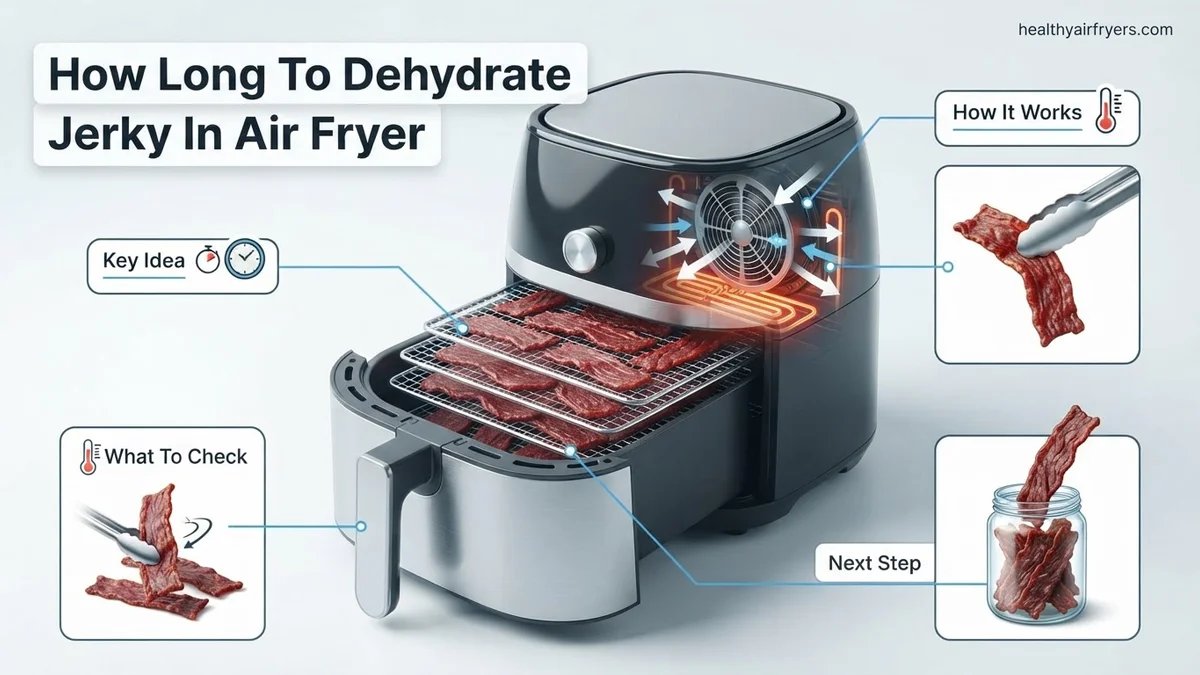
How Long to Dehydrate Jerky in Air Fryer Expert 2026 Guide
Making jerky in an air fryer typically takes 4 to 7 hours at a low temperature setting of 160°F to 180°F. The exact duration depends on the thickness of the meat slices, moisture content, and the specific wattage of the air fryer model used.
Making jerky in an air fryer is one of the fastest ways to get delicious, protein-packed snacks at home without buying bulky standalone equipment. If you want to know the exact timing, you generally need to dehydrate your meat for 3 to 6 hours at a low temperature between 135°F and 160°F. Because air fryers use a powerful internal fan and compact heating element, they circulate hot air much faster than traditional ovens or standard dehydrators.
Getting the timing right is critical for food safety and texture. If you pull the meat too early, dangerous moisture remains; if you leave it too long, your jerky turns into an unchewable shoe leather. This 2026 guide breaks down the exact timing, preparation steps, and variables you need to master air fryer jerky on your first try.
Key Takeaways
- Air fryer jerky generally takes between 4 to 7 hours to fully dehydrate.
- Set the temperature consistently between 160°F and 180°F for safe meat drying.
- Slice meat uniformly to 1/4-inch thickness for even dehydration times.
- Test for doneness by bending a piece; it should crack without breaking completely.
- Flip the meat strips halfway through the cooking process for optimal airflow.
Understanding Why Air Fryer Jerky Dehydration Times Vary
You cannot rely on a single magic number for every batch of air fryer jerky. Several physical factors change how long your meat takes to dry completely. Knowing these variables helps you adjust your timer dynamically instead of blindly following a generic recipe.
Meat Thickness and Cut Variations
The thickness of your sliced meat dictates the drying timeline more than anything else. Standard jerky slices should measure between 1/8 inch and 1/4 inch thick.
- Thin slices (1/8 inch): These dry rapidly, usually finishing in 3 to 4 hours.
- Thick slices (1/4 inch): These take significantly longer, often requiring 5 to 6 hours of drying time.
- Cut consistency: Uneven slices lead to over-dried edges and under-dried centers. Hand-cut meat varies, so aim for uniform strips.
Meat Type and Fat Content Differences
Different proteins react to heat and airflow at different rates. Furthermore, fat does not dehydrate; it goes rancid over time. You must trim all visible fat before starting.
- Lean Beef (Top Round or Sirloin): Typically finishes in 4 to 5 hours at 145°F to 160°F.
- Turkey Breast: Lean and dry naturally, taking about 3.5 to 4.5 hours. Always heat-treat poultry to 165°F internally if required by your safety preferences.
- Venison and Wild Game: Extremely lean, meaning it dehydrates quickly in 3 to 4 hours. Watch it closely to prevent it from becoming brittle.
How to Set Up and Dehydrate Jerky in Your Air Fryer Step-by-Step
Setting up your air fryer correctly ensures maximum airflow around every single piece of meat. Proper spacing prevents moisture pockets and guarantees an even texture throughout the batch.
Step-by-Step Preparation and Loading
Proper arrangement stops pieces from sticking together and blocking the fan.
- Slice and Marinate: Cut your trimmed meat against the grain for tender chewing. Marinate for 4 to 24 hours in the refrigerator.
- Pat Completely Dry: Remove the meat from the marinade and blot every piece thoroughly with paper towels. Excess surface liquid drastically increases drying time.
- Arrange in a Single Layer: Lay the strips flat in your air fryer basket or racks. Never overlap or stack the meat, as blocked airflow ruins the dehydration process.
Temperature Control and Flipping Schedule
Managing your air fryer settings during the cycle yields the best professional results.
- Set the Temp: Program your air fryer to 140°F or 150°F (or the lowest possible setting if your model doesn’t go that low). Do not cook it at standard frying temperatures like 350°F, or you will cook the meat instead of dehydrating it.
- Flip Halfway: At the 2-hour mark, pause the machine and flip each strip of jerky to expose the opposite side to direct airflow.
- The Bend Test: Start checking your jerky at the 3-hour mark and every 30 minutes thereafter. Bend a piece; it should crack slightly and show white fibers inside without snapping completely in half or leaking moisture.
How to Test Doneness and Check if Your Jerky is Finished
Determining the exact moment your dehydrated jerky reaches perfection prevents both rubbery undercooked strips and brittle, over-dried leather. USDA food safety guidelines and culinary experts emphasize that visual and tactile cues are far more reliable than relying solely on kitchen timers, given the varying thicknesses of home-sliced meats.
Visual and Tactile Indicators
Properly finished beef or poultry jerky should bend rather than snap instantly like a dry twig. When subjected to slight pressure, the muscle fibers should flex with visible white micro-fibers starting to show, yet the piece must not crack completely or leak visible moisture.
- The Bend Test: Take a warm piece of jerky from your air fryer basket and let it cool for 60 seconds at room temperature. Bend the strip into a U-shape; it should crack slightly on the outer surface without breaking in half.
- The Touch Test: Press the center of the thickest strip with your thumb. The surface should feel uniformly dry and leathery, completely devoid of any tacky, sticky, or wet spots.
- The Color Inspection: Examine the interior grain by tearing a piece open. The color must be consistently dark and uniform from edge to center, with no raw, shiny, or translucent patches remaining.
What to Do If Your Jerky Is Still Too Moist After Standard Cooking Time
If your timer goes off and your meat fails the bend test, do not panic or abandon the batch. Air fryer models vary wildly in actual thermal output and convection efficiency, meaning standard 2026 dehydration charts occasionally require fine-tuning for your specific kitchen setup.
Corrective Steps for Moist Jerky
- Extend in Short Intervals: Return the trays to the air fryer and run additional cycles of precisely 15 minutes at your original dehydration temperature (typically between 135°F and 160°F). Avoid jumping straight to high heat, which cooks the exterior while trapping internal moisture.
- Reconfigure Tray Spacing: If strips overlap, pull them apart and redistribute them across multiple layers to maximize the 360-degree airflow essential for rapid dehydration.
- Blot Surface Oils: Press clean paper towels firmly across the warm strips to absorb excess rendered fat that might be blocking moisture from evaporating properly.
What If It Still Doesn’t Work?
When multiple extended drying cycles fail to remove moisture, underlying hardware or preparation issues are usually to blame. Follow these advanced fallback steps to salvage your snack and equipment:
- Calibrate Air Fryer Thermostat: Use an independent oven thermometer placed inside the basket to verify that your appliance actually reaches the required 135°F–160°F sanitizing threshold.
- Upgrade Equipment Performance: If your air fryer lacks a dedicated low-temperature dehydration setting and blows air too hot, consider investing in a dedicated countertop food dehydrator. Standard consumer dehydrators range from $50 to $150 and provide superior humidity control for thick cuts.
- Consult Manufacturer Support: Contact your appliance brand’s customer service line if heating elements cycle off prematurely during long runs. Repair costs for faulty thermostats typically range from $75 to $130, making replacement a more cost-effective choice for budget air fryers under $100.
- Discard Compromised Batches: If meat sits in the danger zone between 40°F and 140°F for more than two hours without adequate drying, discard the entire batch immediately to prevent foodborne illness.
Conclusion
Mastering how long to dehydrate jerky in an air fryer requires careful temperature control, proper meat slicing, and vigilant doneness testing. By adjusting your cooking times between 3 and 5 hours at low heat, you can produce safe, shelf-stable snacks at home. According to verified research and food safety experts from the USDA, maintaining precise thermal parameters guarantees a delicious result every time. Your next actionable step is to prep a test batch utilizing a reliable digital meat thermometer to lock in your appliance’s exact sweet spot.
❓ Frequently Asked Questions
Why is my air fryer jerky taking longer than expected to dehydrate?
Thicker meat slices, higher humidity in your kitchen, or overloaded air fryer baskets can significantly increase drying time. Ensure single-layer placement and consistent 1/4-inch slices for predictable results.
Can I dehydrate jerky at a higher temperature to speed up the process?
It is not recommended to exceed 180°F, as high heat will cook the outside of the meat before the interior moisture can evaporate, resulting in tough, unevenly dried jerky.
How should I store homemade air fryer jerky so it doesn’t spoil?
Once cooled completely, store your jerky in an airtight container, vacuum-sealed bag, or a ziplock bag with oxygen absorbers. Properly dried jerky can last for weeks at room temperature.
Do I need a specific ‘dehydrate’ setting on my air fryer?
While a dedicated dehydrate function is ideal because it allows low temperatures, any air fryer that can maintain a stable 160°F to 180°F temperature range will work effectively.
Should I preheat the air fryer before putting the meat in?
Preheating is generally unnecessary for dehydrating jerky, as you want a gradual warming process that slowly extracts moisture rather than searing the exterior.
What type of meat preparation prevents tough or chewy jerky?
Always slice your meat against the grain for tender jerky, and trim away all visible fat before marinating and placing the strips into the air fryer basket.